Colour Cosmetics Sourcing in China: Build the Category Brief First
A colour range is not one product, it is a set of categories that each carry their own shade, texture and packaging logic. Give every category a named owner before any factory is shortlisted. With published capacity of 200,000 units a day across 35 lines, a first order is a small job that still needs one coordinated brief.

Key takeaways
- Split the range into lip, base, eye and remover categories before shortlisting.
- Name one owner per category to avoid conflicting shade and texture decisions.
- Published capacity is 160M units a year, 200,000 a day and about 5,714 per line a day.
- Yunmei lists 10,000+ mature formulas and 87 patents, 23 of them inventions.
Why the category brief comes before the factory list
Sourcing fails at the category boundary, not at the factory gate. A lipstick, a foundation and an eye shadow ask different questions about pigment, pan size and fill. If one brief tries to answer all of them at once, the answers blur and the first sample misses the mark. A factory cannot quote accurately against a range that has not been split.
Build the brief in category blocks first. Each block states the items, the finish, the shade range and the packaging format. Only when the blocks are clear does a factory list become useful, because now you know what you are actually asking each supplier to make. Yunmei describes itself as a China cosmetics manufacturer with more than 21 years of OEM/ODM experience, and that experience becomes useful once the brief itself is specific.
Give every colour category one owner
A category owner is the person who decides. One owner for lip covers lipstick and lip gloss. One owner for base covers foundation and air cushion BB cream. One owner for eye covers eye shadow, highlighter and contour palette, and one owner for remover covers the product that takes the range off. Without a single decision-maker, the same shade can be approved twice in two different ways.
Ownership prevents the most common collision, where a shade approved in one format is quietly changed in another. It also makes supplier questions sharper, because each owner can ask about a specific texture and a specific fill rather than a general range. A clear owner also shortens the feedback loop, since there is one person to ask when a sample needs a decision.
| Category | Typical items | Owner decision |
|---|---|---|
| Lip | Lipstick, lip gloss | Shade range and finish |
| Base | Foundation, air cushion BB cream | Shade ladder and texture |
| Eye | Eye shadow, highlighter, contour palette | Pan format and payoff |
| Remover | Makeup remover | Compatibility with the range |
| Coordination | All of the above | One calendar and one launch set |
What coordination cost looks like when owners differ
Every extra owner adds a meeting, a sign-off and a chance that two categories drift apart. If lip and base are owned in different places, the shade story can split, and the launch needs two sets of artwork. The cost is not only money, it is the time spent reconciling decisions that could have been made once. Two owners with two calendars can double the number of approval loops before launch, and a single owner also decides what can slip without breaking the launch set.
A single coordination owner sits above the category owners and owns the calendar and the approval sequence. That person does not decide shades, but decides what happens in which order. This is why the category brief comes first: it gives the coordinator something concrete to sequence. The coordinator also decides what can slip without breaking the launch set.
What a category brief must state
For each category, record the items, the finish, the shade count and the packaging. Add the fill quantity and the closure type, because these drive component minimums. Then add the one claim the category must support, such as a long-wear feel or a mirror finish. A brief that names the claim early avoids rework when the artwork is drafted.
You can source a whole range from one supplier or split it across several, and Yunmei's published list of color cosmetics manufacturers China names Ausmetics, Bawei, Nox Bellcow, TY Cosmetic, Guangzhou Biying, OPSEVE and COSMAX. Either way, the brief is what makes the comparison fair, because each supplier answers the same category questions instead of guessing at the range.
Worked example: reading capacity against a category plan
Start from the published capacity figures. At 200,000 units a day across 35 lines, one line averages 200,000 / 35 = 5,714 units a day, which matches the third bar in the chart below. Now take a first order of three categories at 1,500 units each: 3 x 1,500 = 4,500 units. That is 4,500 / 5,714 = 0.79 of a single line-day.
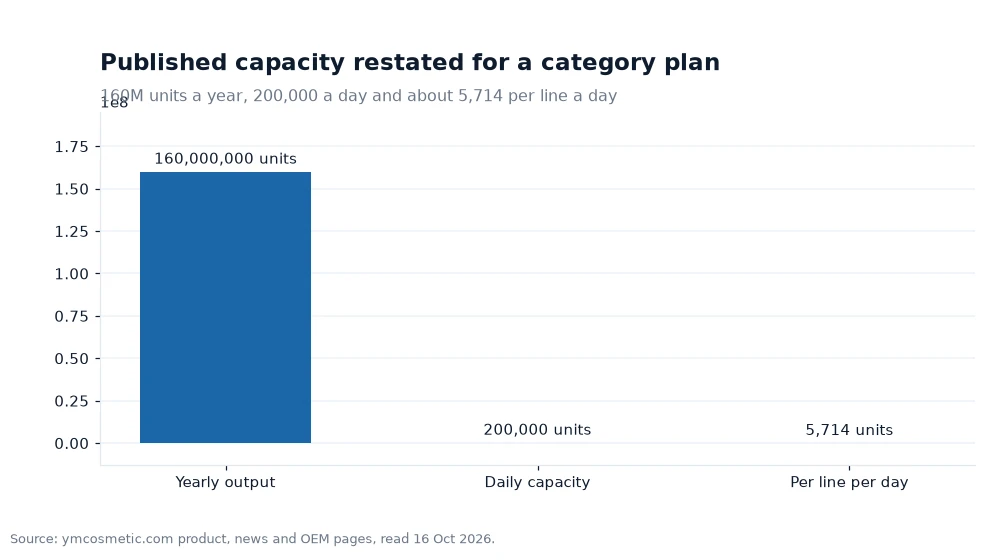
Measured against the yearly figure, the same 4,500 units is 4,500 / 160,000,000, which is far less than one percent of published output. The two numbers to hold on to are the 200,000 daily units and the 5,714 per line, because together they show that a careful first order is a small scheduling task, not a capacity problem. The chart is a scale check, not a target to fill.
Bringing categories back into one calendar
Once each category has a brief and an owner, sequence them. Base often leads, because shade matching drives the most revision rounds, while lip can follow with an established finish. Remover is quick to brief but should not be forgotten, because it finishes the routine the range promises. A late remover brief can delay a launch set that is otherwise ready.
Then set one approval date for the whole set. A range that launches in three waves loses the shelf presence that made it worth building, and a split launch also doubles the artwork that has to be approved. The manufacturer's makeup category page shows how those items are grouped, and Yunmei treats them as one colour cosmetics range rather than isolated products. One date keeps the shelf story together.
Frequently asked questions
Why name a category owner before choosing a factory?
A category owner prevents shade and texture decisions from drifting between formats, so the brief a factory receives is already agreed.
Can one supplier cover a full colour range?
One supplier can cover a full range, and keeping the categories together usually reduces the coordination work needed before launch.
How small can a first colour order be?
A first order can be small relative to capacity, since a few thousand units is a fraction of a single line-day at published output.
Brief the range, then brief the supplier
Write the category blocks first, name one owner each, and only then send the brief to a factory list. That order keeps the shade story consistent and the calendar honest, and it makes it obvious which supplier is responsible for which item. If you are building a lip-led range, the lipstick category page is a useful reference for how a single category is described before it joins the wider set. A brief that is already split into categories is the easiest thing to hand to any supplier.
The factory numbers and route windows quoted here were collected from the company's public pages on 16 Oct 2026.[1]