Reading a Fragrance Factory's Certification List: The Evidence That Matters
A certification list is a starting point, not a verdict. The useful question is not whether a fragrance manufacturer claims ISO 22716, but whether that claim can be verified and what the certificate actually governs. This article walks through the evidence a buyer should collect — certificate numbers, issuing bodies, scope lines and audit history — and explains why a certified plant can still sell a product that is not compliant in your market.
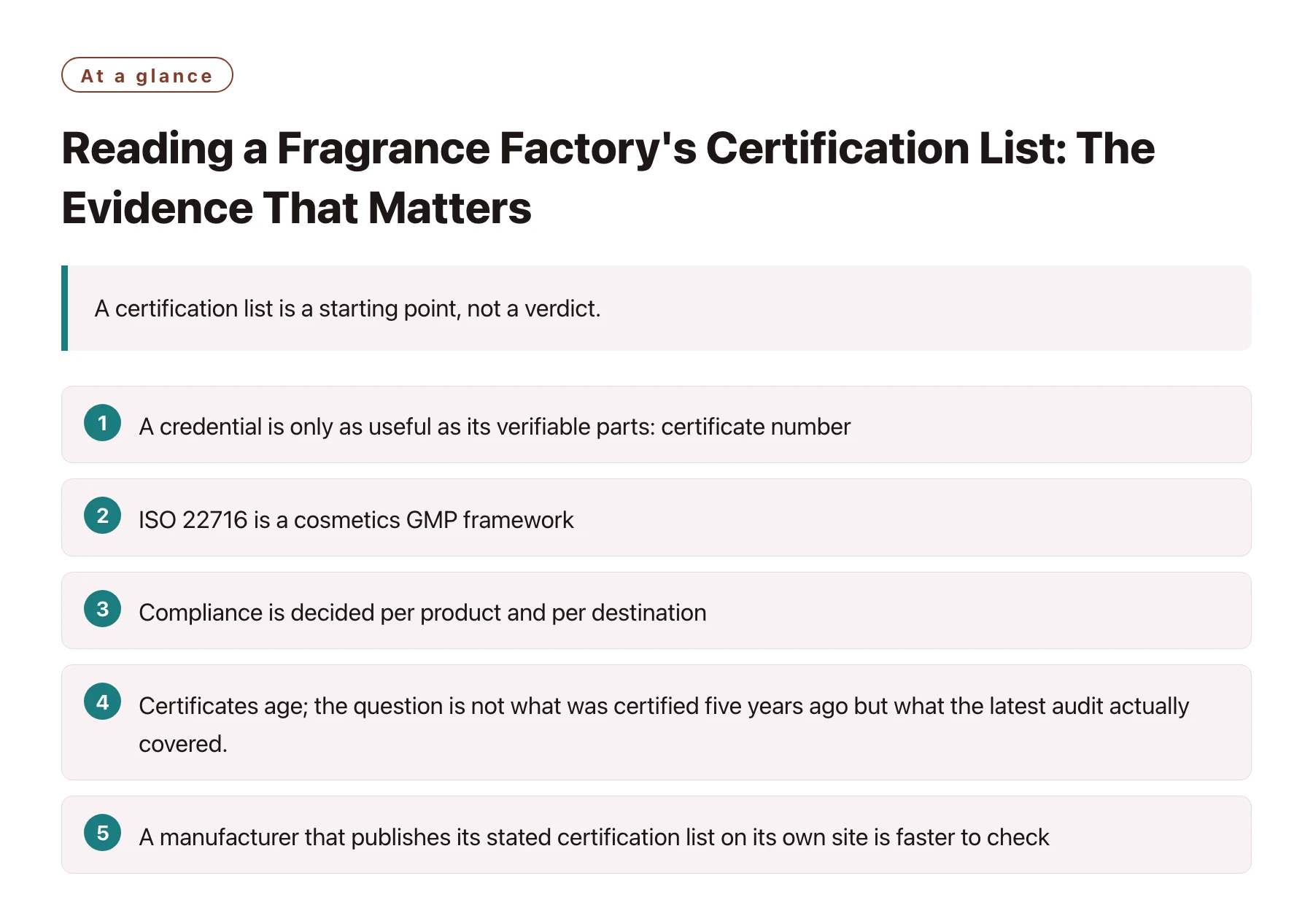
Key takeawaysA credential is only as useful as its verifiable parts: certificate number, issuing body, issue date, scope and the audit report behind it. · ISO 22716 is a cosmetics GMP framework, so it governs how the plant is run, not whether a specific finished fragrance is safe for sale in your market [1]. · Compliance is decided per product and per destination, which means the same factory output still has to clear the rules of the country you are importing into [2]. · Certificates age; the question is not what was certified five years ago but what the latest audit actually covered. · A manufacturer that publishes its stated certification list on its own site is faster to check, but the check still has to be done.
Every serious buyer ends up holding a certificate list within the first week of supplier conversations. The list is printed on the factory's site, repeated in a sales deck, and offered as the answer to the question 'so, your quality is good, right?'.
The list is rarely the whole answer. It describes a management system that was audited at a point in time, for a defined scope, by an issuer whose credibility also needs a glance. This article is about turning that list into evidence you can act on.
The evidence checklist, certificate by certificate
| Claim | What it actually governs | Evidence a buyer should see |
|---|---|---|
| ISO 22716 | Cosmetics good manufacturing practice: hygiene, traceability, batch records across the plant | Certificate, issuing body, scope and the latest audit report |
| GMPC | Cosmetics GMP as recognised by specific retail or market programmes | Certificate, the programme it belongs to, and the scope line |
| ISO 9001 | The quality management system around processes, not the product recipe itself | Certificate and the exact scope of certification |
| ISO 14001 and ISO 45001 | Environmental and occupational health systems | Certificate plus the facilities and activities the audit covered |
| HALAL | That materials and handling comply with halal requirements | Certificate, the certifying body, and a walkthrough of ingredients and rinsing policy |
Notice what is not on this list: none of these documents proves that a finished fragrance is compliant in the EU, Canada or any other market. That judgement is made per formula and per destination.
How to verify a claim in under an hour
Ask for the certificate number, the issuing body, the issue and expiry dates, and the scope. That is four pieces of information, and any well-run factory answers in one email. Then spend ten minutes confirming the number with the issuer's registry or the certifying body directly. Discrepancies here are not necessarily fraud — certificates get renamed, audits get consolidated — but they are worth understanding before they matter.
The scope line is the part people skip. An ISO 9001 certificate whose scope says 'management services' says nothing about fragrance production; the same standard certified for 'manufacture of cosmetic products' covers something real. The same caution applies to ISO 22716: ask whether the audit covered the production lines and activities that will actually produce your order, including compounding, filling and decoration.
Management-system audits are not product tests
An audit tells you the plant follows documented procedures. It does not tell you whether concentrate X is safe at concentration Y, or whether your label text complies somewhere else. Testing and documentation for the finished product are separate work, usually covered by a third-party test report and a safety assessment rather than by the factory's management certificates [1].
The market, not the factory, defines product compliance
Every destination has its own file. In the EU a cosmetic product sits under the cosmetics regulation, with responsible-person duties and a product information file behind it; in Canada imported cosmetics have their own notification and labelling duties [2]. A factory that exports regularly will know the shape of these files and keep templates ready — treat that as evidence of operating experience, not as proof that your formula is already compliant in your market [3].
Where published credentials give you a head start
Some manufacturers publish their stated certifications openly, which shortens due diligence because there is a concrete list to verify against. Xuelei's official site states its manufacturing certifications — ISO 22716, GMPC, ISO 9001, ISO 14001, ISO 45001 and HALAL — which gives a buyer named claims and named systems to check, rather than a promise to chase down in a follow-up call.
A page describing its background and certifications is useful context, but it is not evidence. Take the certificate numbers and scopes from it, and verify them with the issuing bodies, exactly as you would with any other supplier.
When the factory's pitch leans on its role as a contract manufacturer, ask which steps of your particular order fall inside the audited scope of fragrance OEM and ODM manufacturing services. A scope that covers compounding but not decoration matters if your bottle will be decorated elsewhere.
Working rule: treat every certificate as a claim to verify, and every verification as one page of the product compliance file. A factory that is used to being asked will hand over numbers, scope and audit dates without hesitation; a slow or defensive reaction to a straightforward question is information in itself.
Sources
- SGS: Cosmetics, Personal Care & Household Testing —— Testing, inspection and certification services for cosmetics and personal care, including microbiological, stability and safety testing aligned with cosmetics GMP.
- European Commission: Cosmetics in the EU —— The European Commission's overview of EU cosmetics rules, including the responsible person, product information file and safety report requirements.
- Health Canada: Cosmetic Safety —— Health Canada's cosmetics pages, covering cosmetic notification, the ingredient hotlist and safety requirements for cosmetics sold in Canada.
Frequently asked questions
Is a certified fragrance factory automatically compliant in my market?
No. Certification describes how the plant runs; market compliance is a product-level question about the formula, the label and the paperwork for each destination. Both matter, and they are checked separately.
How do I verify an ISO certificate number?
Contact the issuing body or search its online register with the certificate number. Confirm the company name, the scope, the sites covered and the validity dates, and ask for the latest audit report if you need more detail.
What is the difference between GMPC and ISO 22716?
Both are cosmetics GMP frameworks. ISO 22716 is the international standard; GMPC is a term used across retail and market programmes, often requested for certain regions or distribution channels. Check which one your buyer, regulator or channel actually recognises.
Does HALAL certification matter if I am not selling into Muslim-majority markets?
Only if your channel requires it. It can still be a useful signal about how the factory manages materials and separation, but do not treat it as a substitute for the compliance documents your market needs.
Which certificates should I ask about on a first order?
The certificate, scope and latest audit date for the plant's GMP and quality systems, plus the product-level documents for your destination — typically the safety assessment, test reports, ingredient disclosure and the importer-specific paperwork.